
Welcome to Housing 101, our new content series where team members share what current and future homeowners need to know, from historical context to home repairs, succession planning, and more. In our first post, we’ll cover how to read a Property Tax Assessment to ensure you’re getting the tax breaks you deserve. (Note: This applies to Detroit residents only. If you live in another city, reach out to your city assessor to find out what you need to know.)
Property Taxes are often included in your mortgage payment, but it’s up to you to make sure your property taxes are up-to-date. At the beginning of the year, you should receive an envelope in the mail with a yellow paper printed with THIS IS NOT A BILL at the top. This is your Property Tax Assessment, and it is how the City of Detroit calculates what your property taxes will be for the coming year. Let’s dive in!
Vocabulary
Your Property Tax Assessment uses language that most people aren’t familiar with. Check out the image and the corresponding definitions below to break it down:
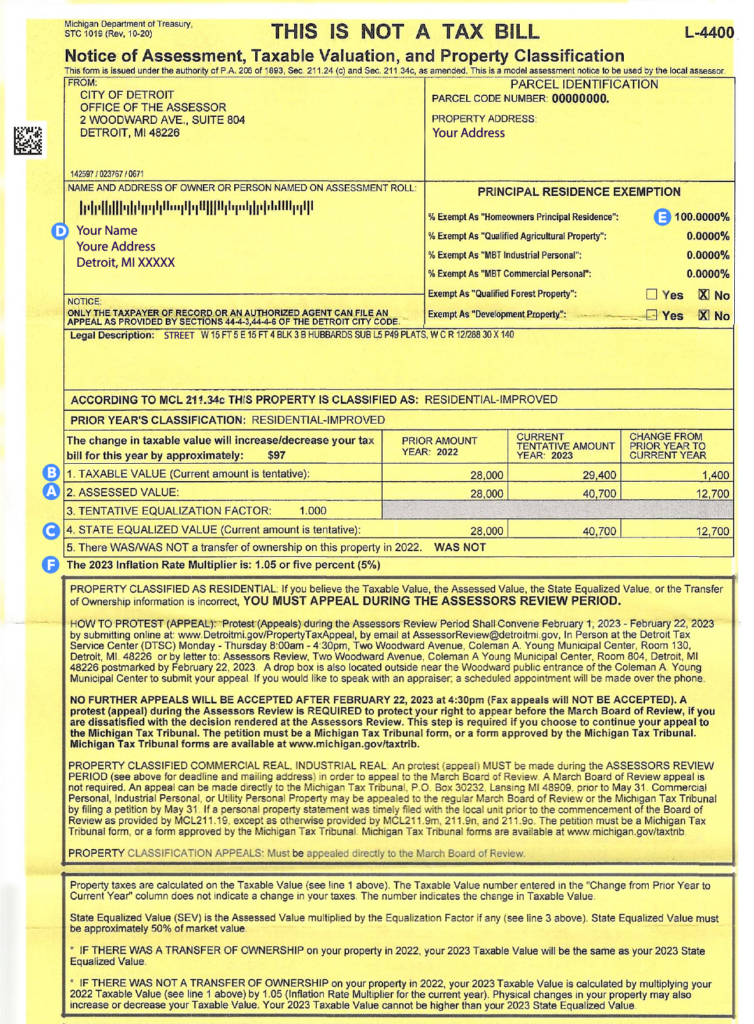
A. ASSESSED VALUE: This is how much of your home’s value the city can tax. This should be half the amount you could sell your house for on the market today. State law requires that assessments cannot be more than 50% of a property’s market value.
B. TAXABLE VALUE: The first year you own a house, this number should match the assessed value. This value is “capped” and cannot fluctuate each year beyond the rate of inflation or 5%, whichever is lower.
C. STATE EQUALIZED VALUE “SEV”: This is the assessed value that has been adjusted following county and state equalization. It’s usually the same as the assessed value.
Things to Check
When you get your notice, you should look for a few things:
- Correct Name: If your tax assessment notice is addressed to a previous owner, you may need to register the property transfer with a Property Tax Affidavit. This should have been done within 45 days of a sale, and there may be a fee for filing late.
- Principal Residence Exemption: If you live in a house you own, your Principal Residence Exemption should show 100% (if you’re in a duplex it will be 50%). This exempts you from paying the tax levied by a local school district for operating purposes, up to 18 mills.
- Am I Being Over-Assessed? If you recently became a homeowner, the assessed value and taxable value will match. While the assessed value is based on similar sales in the area, not on your individual sale, it should be around half or lower than the purchase price. If you’ve owned the house for more than a year, you’ll want to make sure that your taxable value is only increasing by the rate of inflation, which is dictated by the state. The 2023 inflation rate multiplier is 1.05 (or an increase of 5% percent). It if has increased more than that 5%, it could be because your property tax uncapped due to new construction. BOTTOM LINE: If there weren’t any major renovations, and the value listed is significantly more, this might be a sign you’ve been over-assessed.

Think You May Have been Over-Assessed?
For Detroiters, there is a process to appeal your property taxes if you disagree with the changes: You must start the process by submitting an appeal online, in person or by mail during the three week window of Feb. 1-22. United Community Housing Coalition offers one-on-one assistance, and can help you navigate delinquent taxes and exemption applications. Visit their website www.UCHCDetroit.org or call their Tax Hotline at (313) 405-7726.
Want to see assessments in your neighborhood? Check out this map by Regrid. (Source: City of Detroit, Coalition for Property Tax Justice, Regrid)
Struggling to Pay Your Property Taxes?
You may be able to reduce or eliminate your current year’s property taxes with the Homeowner’s Property Exemption Program (HOPE) if you meet income requirements or are experiencing a financial hardship. You can read more and apply online at www.DetroitMI.gov/HOPE.
The City of Detroit offers several payment plans and other options that may help you to avoid foreclosure if you’re behind on your property taxes. United Community Housing Coalition offers one-on-one assistance for property tax help and foreclosure prevention.
The Detroit Tax Relief Fund (DTRF) is administered by Wayne Metro to pay off the remaining property tax balances of Detroit residents who have been approved for HOPE and PAYS. Call (313) 244-0274 to speak with someone from the Detroit Tax Relief Fund Hotline.
Why You Should Care
Understanding your Property Tax Assessment is a valuable tool in your homeownership toolkit. Over-assessments do happen, and can lead to property tax foreclosure if you are unable to pay. Stay on top of your assessment, and stay in the know by following our Housing 101 series.
Click here for more resources.