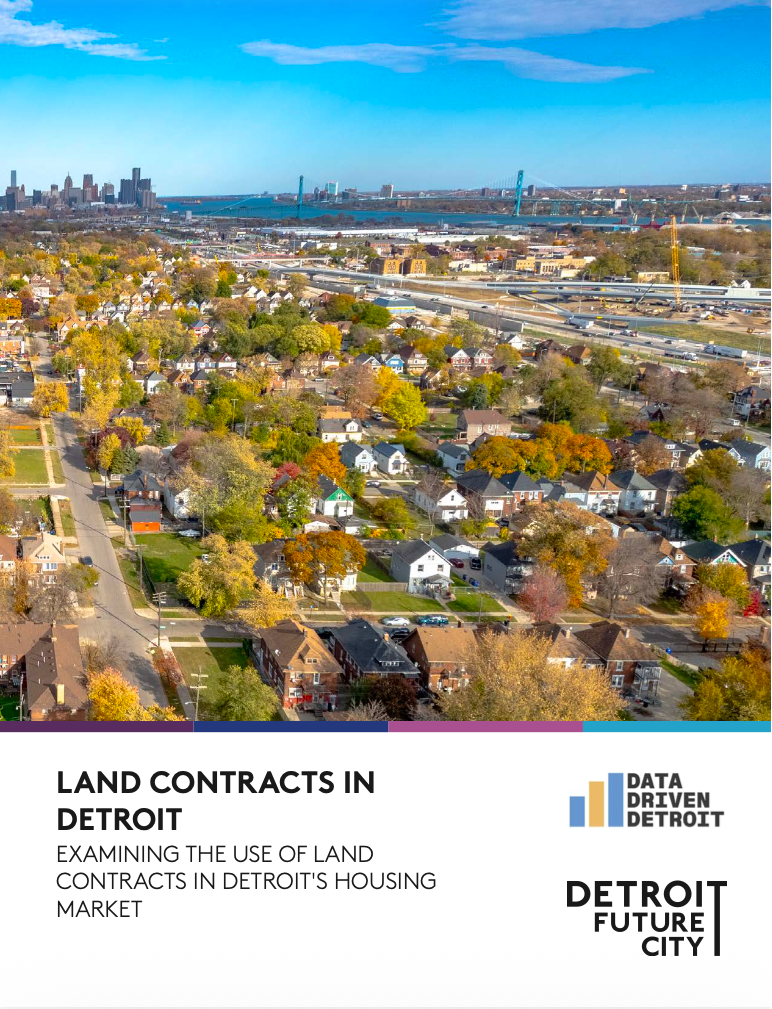
Homeownership in Detroit has never followed a simple path and new research helps explain why. Rocket Community Fund commissioned a report conducted by Detroit Future City and Data Driven Detroit to examine the use of land contracts in Detroit’s housing market. The result is a comprehensive look at who is using this form of seller-based financing, where it is happening across the city and what it means for Detroit’s broader housing future.
Land contracts are a form of financing in which a buyer makes payments directly to the seller over time, only receiving the title to the property once all payments are made. They exist outside of the traditional mortgage market and carry unique risks including balloon payments, loss of equity and limited legal protections. However, land contracts have long served as a pathway to homeownership for Detroiters who cannot access conventional lending.
The report finds that land contracts are not a relic of Detroit’s financial crisis, they are a permanent fixture of its housing market. Since 2008, more than 17,600 land contract transactions have been recorded with the Wayne County Register of Deeds, averaging roughly 1,000 per year. Notably, this figure has remained steady even as mortgage lending in the city has rebounded dramatically, with over 4,300 home purchase mortgages written in 2024 alone. That persistence signals that land contracts are filling a distinct and ongoing need, not simply standing in for mortgages when credit is scarce.
The research also sheds light on who is using land contracts and why. Through focus groups and interviews, the project team identified several key groups: people who do not qualify for traditional financing due to limited credit or irregular income; buyers of properties that don’t meet mortgage lending standards; renters converting to homeownership; and foreign-born residents. Immigrant communities, particularly in Southwest Detroit neighborhoods, show the highest concentrations of land contract activity, often because residents are unfamiliar with or disconnected from the American banking system.
“This research provides important context for understanding how homeownership actually happens in Detroit,” says Beth Sorce, Senior Director, Housing Stability, Rocket Community Fund. “Land contracts can be a meaningful tool when used responsibly, and this report helps us understand both the opportunity and the responsibility that comes with them.”
The findings also point to critical gaps in protections for buyers. Because land contracts exist outside the regulatory framework that governs traditional mortgages, buyers can be particularly vulnerable to predatory terms. The report underscores the need for culturally relevant counseling, translation services and legal resources to ensure buyers fully understand what they are signing before a contract is executed.
At the same time, the research highlights that land contracts are not inherently harmful. Several Detroit nonprofits, including Bridging Communities and United Community Housing Coalition, have used land contracts as responsible tools to extend homeownership opportunities to people and properties that wouldn’t otherwise qualify for a mortgage.
The data paints a nuanced picture of Detroit’s housing landscape, one where land contracts occupy the space between the city’s most stable, mortgage-accessible neighborhoods and its most vulnerable areas. Understanding and responsibly supporting this market is essential to expanding equitable homeownership across the city.
Read the full report by clicking the image below.