Homeownership represents the cornerstone of the American Dream—a pathway to prosperity, financial security, and generational wealth. Yet systemic barriers have long denied this opportunity to many Americans. Throughout 2025, we worked alongside community partners across Detroit and beyond to transform this reality by helping families stay in their homes, achieve sustainable homeownership, and build lasting financial security. Our comprehensive strategy addresses housing stability at every stage—from preventing displacement to expanding repair resources to fostering financial literacy—ensuring that the American Dream remains within reach for all.
Preventing Displacement, Creating Homeowners
When families face displacement through no fault of their own, we step in with solutions that transform renters into owners. One example is the Make It Home program. Thanks to this partnership between Rocket Community Fund, the City of Detroit and United Community Housing Coalition, 168 more Detroit families became homeowners in 2025, bringing the total to over 1,700 families since the program’s launch in 2017. Most were renters whose landlords failed to pay property taxes, putting them at risk of eviction. Instead of losing their homes, these residents purchased them through zero percent interest land contracts, with payments averaging $6,500.
Make It Home leverages the City’s “right of refusal” to purchase properties before tax foreclosure auctions for the value of back taxes owed. UCHC then purchases these properties using philanthropic funding from Rocket Community Fund and others, selling them at cost to occupants with affordable payment plans. Residents make payments for roughly 1–2 years until they reach the purchase price, then receive their deeds and gain access to home repair grants, loans, and financial counseling. The program also supports families facing displacement due to inadequate estate planning. Detroit resident Daryl Thompson, for example, was able to keep his childhood home in the Hubbell-Puritan neighborhood after his mother’s passing in 2017.
Our $1.16 million commitment this year supported new homeowners and funded critical repairs for Make It Home participants. This year alone, we committed an additional $750,000 to the repair program, bringing our total support for repair funding to $4.75 million since 2019. To date, 580 homes have now benefited from these Make It Home-associated repair resources, addressing the deferred maintenance many participants inherit from former owners.
For some families, traditional repair programs aren’t enough. Our innovative Home Swap Program addressed this gap by helping three families trade properties with extensive repair needs for fully renovated, furnished Detroit Land Bank Authority homes in their neighborhood. When Danielle Welcome and her four children received the keys to their newly rehabbed home just before Christmas, she called it “beyond words”—a dream come true made possible through collaboration with the City of Detroit, Enterprise Community Partners, and Detroit Home Repair Fund partners including GHHI, and others. Each home was custom decorated by Humble Design, providing families not just shelter, but a true sense of home.
Housing Those Who Served
Our mission to help everyone home includes those who have sacrificed so much in service to our country. In summer 2025, Detroit launched #75DaysZeroExcuses, an ambitious citywide housing surge to quickly house approximately 120 veterans experiencing homelessness. The goal: cut the time it takes for a veteran to move into permanent housing by more than half, aiming to house veterans within 75 days and achieve “functional zero”—the point at which available temporary beds equal or exceed the number of veterans experiencing homelessness at any given time.
Since 2018, our partnership with Built for Zero—a national movement led by Community Solutions—has already contributed to a 50% reduction in veteran homelessness in Detroit. Now, in support of the Veteran Leadership & System Improvement Council (VLSIC), we’re working together to speed up placements, prevent new cases, and strengthen long-term stability. We deepened our commitment by funding dedicated system-lead positions, providing flexible funds to remove housing barriers, sponsoring diversion training, and continuing to support Community Solutions as a strategic partner. When Detroit reaches functional zero, it will be one of the first large U.S. cities to do so—proof that when we believe homelessness can be solved, we can make it a reality.
Strengthening Detroit’s Housing Foundation
Safe housing requires ongoing investment in repair and maintenance. The Detroit Home Repair Fund (DHRF), launched by Gilbert Family Foundation in 2022, has now delivered over 6,000 critical repairs to more than 600 homes, improving health and safety for over 1,300 Detroiters. On average, DHRF homes are nearly 100 years old, with 97% failing to meet basic survivability standards when entering the program. The $28,600 average repair cost per home addresses hazards like roof leaks, failed plumbing, lack of heat, and unsafe wiring—repairs that are especially critical for the 46% of participating households with members aged 62 or older, which saw an 80% drop in falls among elderly residents.
The 2024 Home Repair Census—the first citywide assessment of Detroit’s repair landscape, made possible through support from the Rocket Community Fund—documented over 3,058 repair interventions worth more than $50 million across at least 30 organizations and 31 unique programs. This baseline data will help track changing repair outcomes over time and identify where additional resources could make the biggest impact. Roof repairs were most common (28.9%), followed by plumbing (14.1%) and HVAC (11.5%), reflecting the urgent needs of Detroit’s aging housing stock.
These coordinated investments are preventing displacement at its source. Wayne County reached record-low tax foreclosures in 2024—just 2,111, the lowest since 2003 and down from a peak of 28,323 in 2015—thanks in part to the Detroit Tax Relief Fund established by Gilbert Family Foundation and our Neighbor to Neighbor canvassing program. Our 2024 Neighbor to Neighbor report documents the impact of this direct outreach approach: canvassers reached 63,292 parcels throughout Detroit, with 51% of properties providing information about their housing needs. This door-to-door engagement connects residents facing property tax delinquency with critical resources like the HOPE program and the Detroit Tax Relief Fund, while collecting data that informs our housing stability strategy and investments.
Building Financial Futures Beyond Homeownership
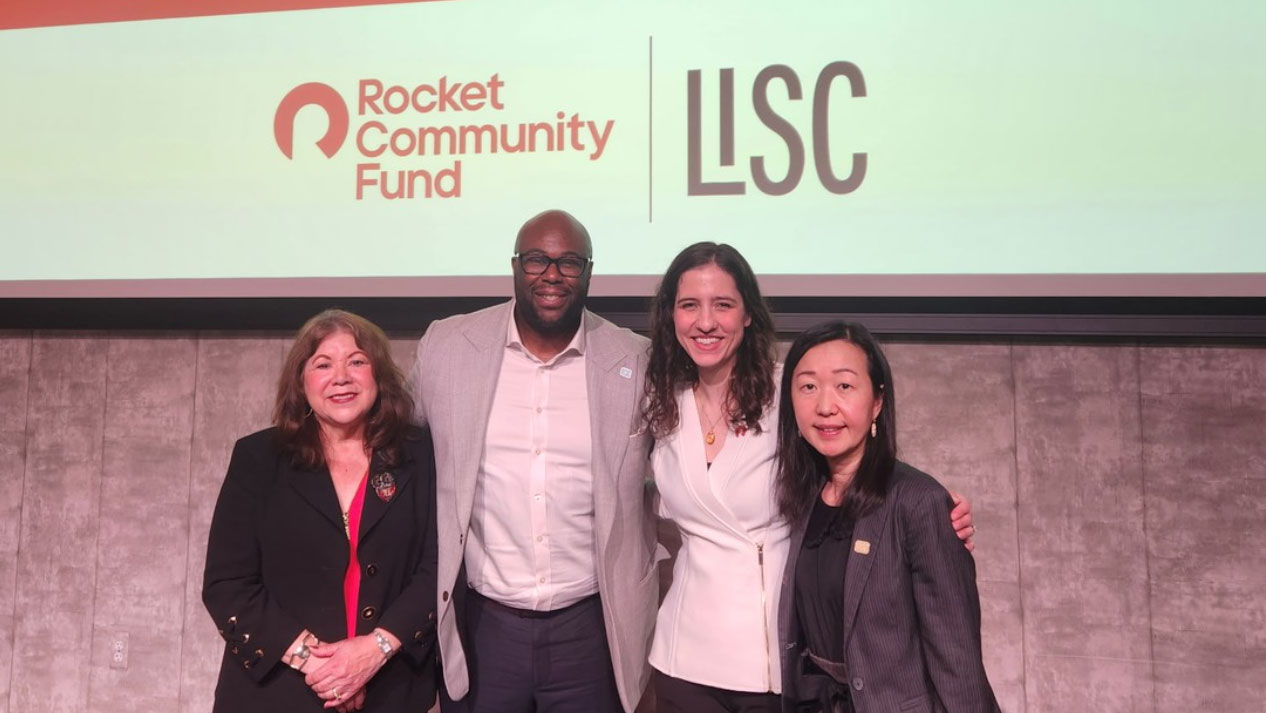
Owning a home is just the beginning of building generational wealth. The Rocket Wealth Accelerator Program, launched in 2022 through our $2 million partnership with LISC, has supported over 3,100 community members with financial coaching and goal-setting. In 2025 we invested an additional $2.25M into the Rocket Wealth Accelerator program in Detroit, Cleveland, Flint and Toledo. More than 600 participants have collectively saved over $530,000, leveraging one-to-one savings matching—up to $500 for large purchases like homes or vehicles and up to $300 for emergency savings—along with credit counseling, budgeting support, and employment services.
Detroit native Romell Johnson exemplifies the program’s impact. Through credit counseling and the savings match program, he purchased a car to reach his new construction job. “I started challenging myself to save more, spend less,” Johnson said. “The program matches what you save. I said, ‘Okay, I’m about to put in as much money here as possible.'” His ultimate goal: building credit to achieve homeownership—exactly the sustainable path the Rocket Wealth Accelerator is designed to create.
We’re also creating new pathways to credit-building for renters who haven’t yet achieved homeownership. Our $250,000 investment in Credit Builders Alliance launched a rent reporting pilot program across Detroit, Flint, and Pontiac, partnering with six nonprofit affordable housing providers including Bridging Communities, Inc., Lighthouse MI, U Snap Bac, Communities First, Inc., Micah 6 Community, and The Weston Hall in Detroit, Flint, Pontiac, Toledo, Cleveland, and Cincinnati. The “positive-only” approach reports on-time rent payments to credit bureaus without negative impacts, helping tenants increase credit scores by 15–50 points—a transformative improvement for qualifying for mortgages and other financial products essential to building wealth.
Addressing the Full Picture
Our commitment to helping everyone home requires understanding all the barriers families face. A University of Michigan study we funded revealed that 38% of Detroit homeowners without mortgages are uninsured—nearly double the national average of 19.5%—with cost being the primary barrier. Detroit homeowners spend an average of $2,327 annually on homeowners’ insurance, compared to $1,422 for Michigan homeowners overall. Without insurance, families risk losing their investment in their property and are disqualified from certain home loans that could improve property values or monthly cash flow. This insight helps us understand the invisible costs that can undermine housing stability even after achieving homeownership.
Looking Forward
Reflecting on this past year, we see the power of coordinated, comprehensive support. Our housing stability work encompasses multiple strategies, all informed by community needs. We help families avoid displacement and achieve homeownership through collaborative efforts with the City and other partners, while addressing critical repair needs and listening to residents through programs like Neighbor to Neighbor. This flagship citywide canvassing program connects residents at risk of property tax foreclosure with housing resources and collects data that directly informs our housing stability strategy, ensuring our approach remains responsive to community voice.
Together we are addressing both the needs of today and the goals residents have for tomorrow – like building stable financial futures and expanding credit-building opportunities for renters to create pathways to stability, homeownership, and ultimately, prosperity.
As we look toward 2026, we remain dedicated to helping every American home by removing barriers to stable housing, sustainable homeownership, and financial prosperity. Because when families have secure homes and strong financial foundations, entire communities thrive—and that’s the future we’re building together.