The following is a guest post from Autumn Russell, Senior Program Manager, Rocket Community Fund
Something is shifting in Detroit’s tech workforce. Not loudly. Not all at once. But if you’re close to the work — if you’ve sat in those classrooms, heard those conversations, watched someone step into an industry that never seemed to be built for them — you can feel it.
It shows up in the certifications being earned in cybersecurity and data analytics. It shows up in conversations that have quietly moved past “getting a job” toward something longer and harder to name: a career. A future with a shape to it. And it shows up in the growing number of Detroiters stepping into the tech sector that – for a long time – didn’t even know that these curious, talented folks existed.
None of this progress happens by accident. And none of it happens without people who stay committed to making it real.
At Rocket Community Fund, we’ve spent the last several years investing in the partners who are creating new opportunities for Detroit talent in this rapidly growing space. Honestly, we are still learning as much from them as we’re contributing. What keeps coming back to us is this: when opportunity is built the way it should be, with nuance and consideration, it doesn’t feel like access. It feels like alignment. Like something that was always supposed to be there, finally showing up.
The Opportunity — and the Gap That Still Exists
According to a report recently published by Detroit Future City, the tech sector has grown significantly over the past decade, with more than 74,000 jobs and over $24 billion contributed to the regional economy annually. For employers and civic leaders, those numbers signal something real about where this city is headed.
But the harder story — the one worth sitting with — is that too many Detroiters have watched that growth from a distance. Not because the talent wasn’t there, but because the invitation and pathways weren’t.
Closing that gap takes more than goodwill or a single funding cycle. It takes trust, sustained relationships, and dedicated partners whose commitment is real.
That’s what organizations like Per Scholas, NPower Michigan, Detroit School of Design and Technology, and Focus: HOPE represent. They’re not just training providers. They’re the connective tissue between Detroit’s residents and Detroit’s economy, and they’ve been doing this work with real consistency and real results.
Real Results from Committed Partners
For anyone evaluating where to invest — whether you’re an employer looking for talent or a civic leader thinking about economic impact — the outcomes are worth paying attention to.
Per Scholas Detroit has trained more than 600 learners, with nearly 80% employed within one year and more than $15 million in first-year wages flowing back into the local economy. That’s not just a program success — that’s a neighborhood changing.
NPower Michigan has achieved 100% credential attainment among recent graduates, with more than half of participants coming directly from Detroit. These are people who are job-ready, employer-aligned, and entering the market now.
DSDT (Detroit School of Design and Technology) is preparing Detroiters for careers in AI, cybersecurity, and data infrastructure at exactly the moment those fields are reshaping what the economy looks like — with dozens already in roles and more building toward them.
Focus: HOPE has demonstrated something that’s harder to measure but even more impactful: what it looks like when you invest in the whole person. By pairing technical training with case management and wraparound support, over 150 cohort participants have all completed, and over 80% working in the industry since 2024. Very often, the difference comes down to whether someone feels truly supported by the process or left to navigate it alone.
These aren’t isolated wins. They’re proof of what’s possible when organizations stay committed and the resources and relationships are there to back them up.
Beverly’s Story — Extraordinary in Action
Behind every data point is a decision someone had to make, usually under pressure, usually without a guarantee of how it would turn out.
Beverly Troy made hers in the middle of one of the harder chapters of her professional life.
She first walked into Black Tech Saturdays in July 2024, after a friend mentioned it. From the moment she arrived, something clicked — the energy in the room, the people, the sense that something genuinely purposeful was happening there. She came back, and kept returning. Before long she wasn’t just attending, she was helping to lead — volunteering, helping coordinate speakers at the 2024 Summit, building relationships with people she never would have met otherwise.
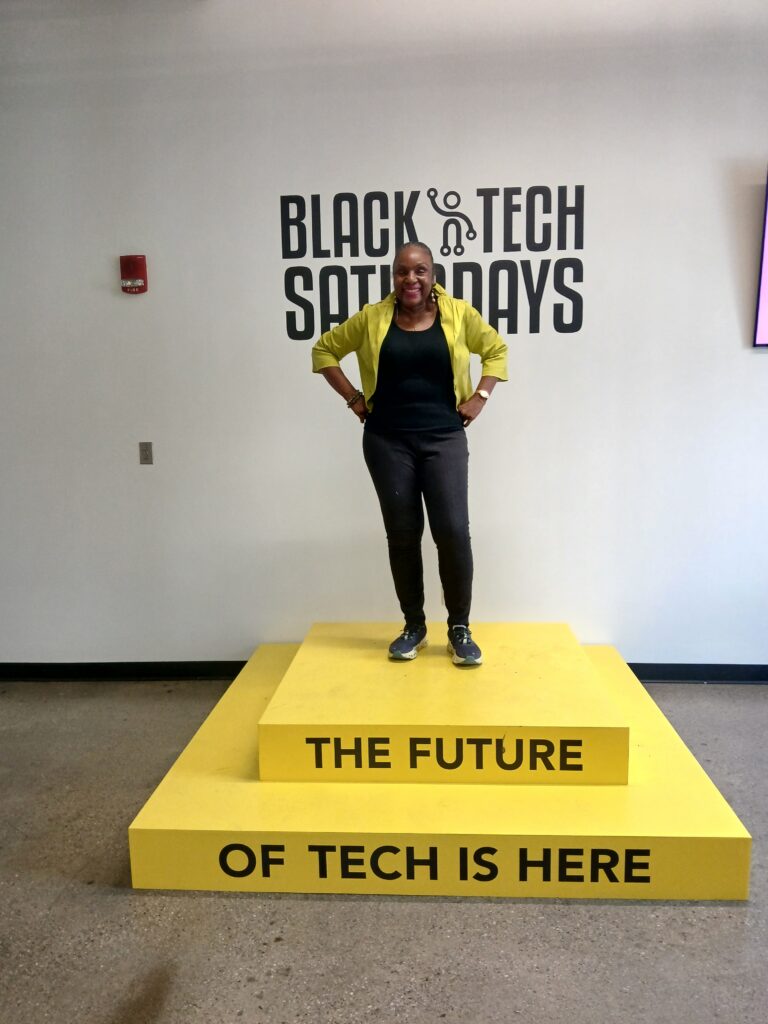
Thanks to programs like Black Tech Saturdays, Per Scholas and Apple Developer Academy, Beverly built a new career in tech as a Security Analyst.
Through those connections, Beverly discovered two programs she hadn’t known existed in her own city: the Apple Developer Academy and Per Scholas.
Then she was laid off.
What Beverly was navigating wasn’t just a job transition. She was facing something that doesn’t get talked about enough in workforce conversations — ageism. The challenge of entering a tech sector that can mistake experience for irrelevance. It would have been easy, and completely understandable, to step back.
Instead, she enrolled in the Apple Developer Academy, completed the Per Scholas Cybersecurity program, and secured a position as a Security Analyst.
Her advice to others in the community? “Be bold, be courageous, and be prepared to walk into your new extraordinary version of you.”
Beverly’s story works because of what surrounded her: a community that made her feel like she belonged, training that prepared her for something real, and people who stayed in her corner through the whole journey. That combination — community, training, and sustained support — is what our partners build every day for people across this city. And it’s exactly what we need to sustain this critical work.
What We’re Still Learning
Progress is real. It’s accelerating. And there’s still more to build.
The Detroit Future City Tech Tomorrow report reflects what we hear directly from partners: the ecosystem is growing, demand is genuine, and the pipeline is producing. It also names something we already know to be true — that the work of connecting talent to opportunity doesn’t end at program completion. The coordination between training, employers, and hiring systems is still evolving, and the gap between “certified” and “hired” is still a place where people can fall through.
Our partners are doing an enormous amount to close that gap — building employer relationships, supporting participants through the placement process, making the calls and introductions that don’t show up in any program description but matter more than almost anything else. They’re absorbing a lot. And that work — the retention support, the job placement follow-through, the sustained presence after the certificate is earned — is exactly where dedicated funding and innovation makes the most difference.
Where We Go From Here
We’re at a moment in Detroit’s tech workforce story where the foundation is genuinely solid. The partners are proven, the talent is ready, and the momentum is real.
What the ecosystem needs now is the investment to carry people all the way through — not just to certification, but into careers that hold. For employers, there’s a talent pipeline here that’s already producing the cybersecurity professionals, data analysts, and technically skilled workers your teams need. The relationships are there to be built. For policymakers and civic investors, this is the moment to move from acknowledging Detroit’s momentum to resourcing it — especially the retention and placement services that turn training into lasting economic impact.
As for us, we’re going to keep showing up in this work — as investors, as connectors, and as partners who believe that when someone in Detroit decides to bet on themselves, the system around them should be ready to bet on them too.